
A quick summary
Baby-led weaning (BLW) and traditional spoon feeding are two different approaches to introducing complementary foods to babies. With baby-led weaning, babies are offered appropriately prepared finger foods and encouraged to feed themselves. Traditional spoon feeding generally begins with mashed, pureed or soft foods offered by a parent or caregiver. Neither approach is automatically “better”. What matters most is that complementary feeding begins when your baby is developmentally ready, foods are nutritious and safely prepared, and feeding remains responsive rather than forced.
The good news is that parents do not have to choose one approach rigidly. A combination of self-feeding, finger foods and spoon feeding can be a practical and developmentally appropriate way to introduce solids.
Baby-led weaning vs traditional spoon feeding: what is the difference?
Few parenting decisions create quite as much debate as introducing solid foods. One parent may be confidently offering their six-month-old strips of soft-cooked vegetables, while another is carefully preparing a smooth puree. Then someone mentions baby-led weaning, and suddenly parents are wondering whether they have been doing it “wrong” all along.
The truth is much less dramatic.
Baby-led weaning vs spoon feeding is not really a question of which parenting philosophy wins. Both are methods of complementary feeding, and both can introduce a baby to a wide variety of tastes, textures and nutrients. The most important considerations are when to start baby-led weaning or other complementary foods, whether the baby is developmentally ready, what foods are offered, how safely they are prepared, and how responsive the adult is to the baby’s cues.
The NHS recommends introducing solid foods at around six months, alongside breast milk or first infant formula. At this stage, babies are developing the skills required to manage different textures, move food around their mouths and begin feeding themselves.
The World Health Organization also recommends complementary foods from around six months, emphasising that they should be adequate, nutritious, safe and offered responsively according to the baby’s hunger and satiety cues.
So, rather than asking, “Should I do baby-led weaning or spoon feeding?”, a more useful question may be:
“How can I help my baby learn to eat safely, confidently and enjoyably?”
That shift in thinking takes away a lot of unnecessary pressure.
What is baby-led weaning?
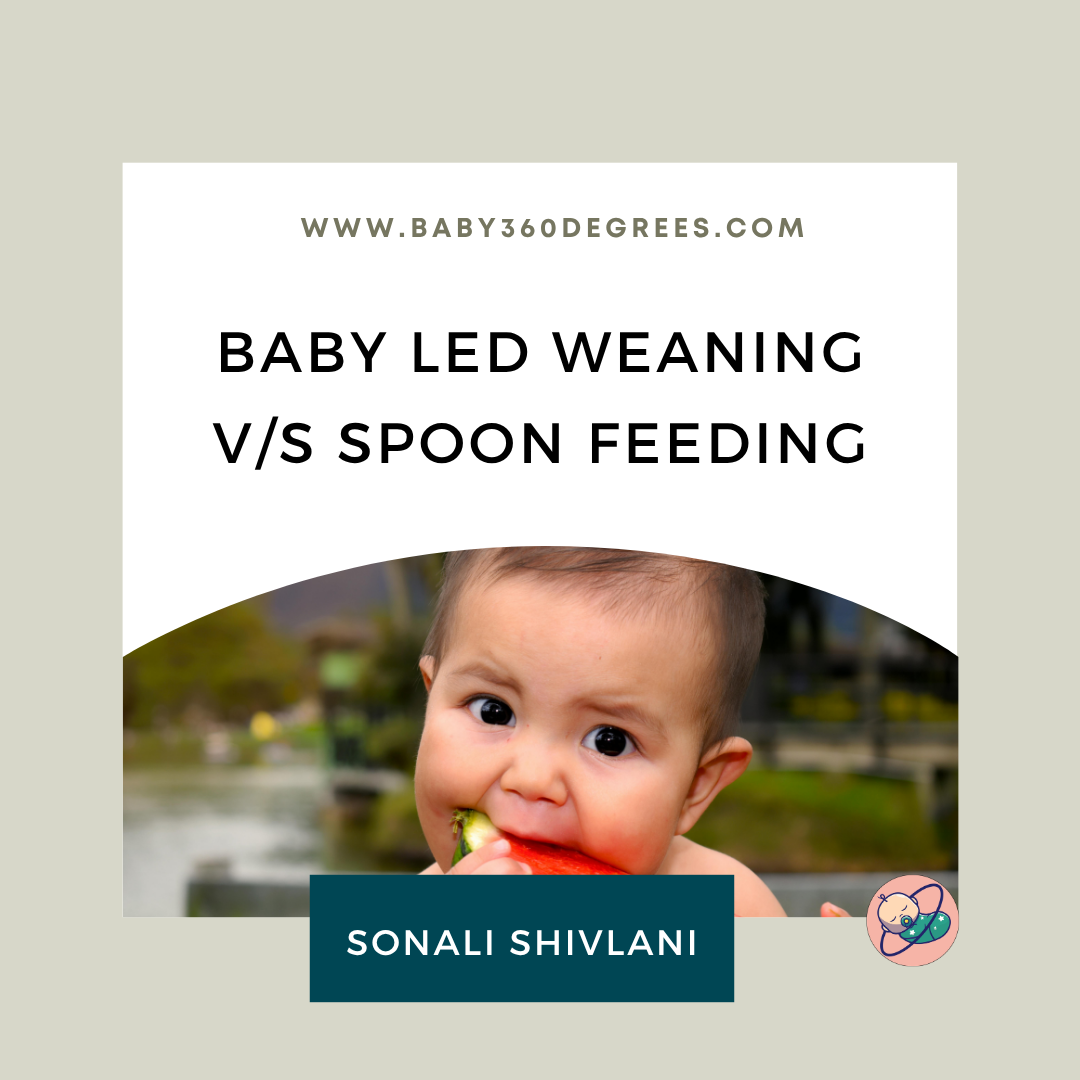
Baby-led weaning, commonly called BLW, is an approach where babies are offered appropriately prepared pieces of food that they can pick up and explore themselves rather than being primarily fed by an adult with a spoon.
The baby is encouraged to participate actively in the meal. Food may be picked up, squeezed, mouthed, chewed, dropped and eventually swallowed. In the early days, eating can look surprisingly inefficient!
That is normal.
Baby-led weaning is about much more than getting food into the baby’s stomach. Mealtimes are also an opportunity for babies to learn about texture, taste, smell, temperature and the physical skills involved in eating.
A baby may initially consume very little. The experience itself is part of the learning process.
Importantly, BLW does not mean giving a six-month-old exactly the same food an adult is eating. Family foods need to be adapted to make them suitable in texture, size and preparation, and foods that present a choking risk need to be avoided or modified appropriately.
What is traditional spoon feeding?
Traditional spoon feeding usually involves offering a baby smooth or mashed foods on a spoon, gradually progressing towards thicker, lumpier and more textured foods.
This might begin with foods such as mashed vegetables, fruit, porridge, yoghurt or other suitable complementary foods. As the baby develops, textures become progressively more varied and the baby begins to manage soft lumps and finger foods.
There is nothing inherently wrong with starting with purees or mashed foods. In fact, WHO guidance states that pureed, mashed and semi-solid foods can be introduced from around six months, while textures and variety should gradually increase as the child develops.
The potential problem is not the spoon itself. The concern arises when babies remain on completely smooth purees for too long or when adults continue to control how much a baby eats rather than responding to the baby’s hunger and fullness cues.
The goal should always be progression.
Baby-led weaning first foods: what can you offer?
One of the biggest questions parents ask is, “What are the best baby-led weaning first foods?”
There is no single perfect first food. Instead, think about offering a variety of nutritious foods in safe, developmentally appropriate forms.
Soft-cooked vegetables can be excellent options. Broccoli florets, sweet potato, carrot, pumpkin, courgette and other vegetables can be cooked until soft enough to squash easily between your fingers.
Soft fruits can also work well. Banana, ripe pear, avocado, ripe mango and appropriately prepared melon are examples.
But baby-led weaning should not become synonymous with fruit and vegetables alone.
Iron-rich and protein-rich foods are particularly important during complementary feeding. Depending on your family’s dietary pattern, appropriate options can include well-cooked egg, lentils, beans, tofu, paneer, meat or fish prepared in a suitable texture.
For Indian families, there is no need to abandon familiar foods and start preparing a completely separate “baby menu”. Soft idli, dal, well-cooked vegetables, soft rice preparations, khichdi, egg, paneer and appropriately modified family foods can all form part of a baby’s complementary diet.
The key is not whether the food looks like a traditional “baby food”. The key is nutritional value, preparation, texture and safety.
When to start baby-led weaning?
A common search query is “when to start baby-led weaning?”, and the answer is generally around six months, provided the baby is developmentally ready.
Age alone should not be the only consideration.
A baby should be able to sit upright with good head and neck control and show the developmental readiness needed to handle food safely. The NHS advises waiting until around six months and looking for signs that a baby is ready for solid foods rather than starting simply because the baby appears interested in what adults are eating.
Premature babies may need individualised advice about when to begin complementary feeding, so parents should discuss this with their healthcare professional.
It is also important to remember that reaching six months does not mean a baby suddenly needs three large meals a day. Complementary feeding begins gradually. Milk feeds continue to be important while the baby learns to eat.
Spoon feeding vs baby-led weaning: the real comparison
So, what happens when we put spoon feeding vs baby-led weaning side by side?
Independence and self-feeding
BLW places self-feeding at the centre of the process. The baby reaches for food, brings it to their mouth and learns to manage it independently.
Traditional spoon feeding is initially more adult-led, although the baby can still participate. Parents can offer a pre-loaded spoon for the baby to hold, allow the baby to touch the food and gradually encourage self-feeding.
In other words, spoon feeding does not have to mean “Mum puts every mouthful into baby’s mouth”.
Texture progression
One of the advantages of BLW is that babies are introduced to a range of textures from the beginning.
With traditional spoon feeding, parents need to consciously progress from smooth purees to mashed, lumpy and finger foods rather than staying with completely smooth foods for months.
Texture progression is important because eating is a skill. Babies need opportunities to learn how to manage increasingly complex textures.
Family mealtimes
BLW can make family meals particularly straightforward because the baby can participate in the meal, provided the food has been appropriately adapted.
Spoon feeding can also be incorporated into family mealtimes. A baby can sit at the table, eat their own food and observe everyone else eating.
The bigger principle is family participation, rather than whether a spoon is involved.
Mess
Let’s be honest: both approaches can be messy.
BLW often produces spectacular amounts of food on the floor, the highchair, the baby’s clothes and occasionally the dog.
Spoon feeding may look tidier initially, but once a baby discovers how much fun it is to grab the spoon, smear yoghurt everywhere and turn the bowl upside down, the distinction becomes less meaningful.
Mess is part of learning.
Nutritional intake
This is where parents should be thoughtful.
In the early months of complementary feeding, a baby may consume very little solid food, particularly with BLW. Some foods may be mouthed repeatedly without much actually being swallowed.
Parents therefore need to make sure that the foods being offered are nutrient-dense and that complementary feeding is progressing appropriately.
WHO emphasises that complementary foods need to provide sufficient energy, protein and micronutrients as babies’ nutritional needs increase.
Does baby-led weaning prevent picky eating?
This is one of the most common claims surrounding BLW, but it needs a little perspective.
There is considerable interest in whether early exposure to different textures and allowing babies to participate in feeding may support food acceptance and a positive relationship with food. However, it would be an oversimplification to promise parents that baby-led weaning will prevent picky eating.
Children’s food preferences are influenced by temperament, genetics, repeated exposure, family eating patterns and many other factors.
What parents can do is create positive opportunities for learning.
Offer variety. Repeat foods without pressure. Allow the child to decide whether and how much to eat from what has been offered. Avoid turning every meal into a negotiation.
The WHO specifically recommends responsive feeding: encouraging children patiently without forcing them and responding to their hunger and satiety cues.
This principle is arguably more important than whether the first meal arrives on a spoon or in the baby’s hand.
What about choking?
This is probably the biggest concern parents have about baby-led weaning — and rightly so.
Choking is a genuine safety issue with complementary feeding, regardless of whether a baby is eating finger foods or being spoon fed.
Baby-led weaning does not mean giving a baby hard, round, small or otherwise hazardous foods simply because they are capable of picking them up.
Foods need to be prepared appropriately for the baby’s developmental stage. Babies should always eat sitting upright and be supervised by an attentive adult.
Parents should also learn the difference between gagging and choking. Gagging can be a normal protective response as babies learn to manage food. Choking occurs when the airway becomes blocked and requires immediate action.
Foods known to pose choking risks need particular care, including whole nuts, whole grapes, hard raw vegetables and other appropriately identified hazards. Preparation can significantly change the safety of a food.
This is one area where parents should seek proper infant first-aid education rather than relying solely on social media videos.
Is a combination approach better?
For many families, the answer may be yes.
There is no rule stating that a baby who starts with BLW can never be offered a spoon.
In fact, a responsive combination approach can be incredibly practical.
You might offer your baby soft finger foods to pick up independently while also offering yoghurt or porridge on a pre-loaded spoon. You might give the baby a spoon and allow them to attempt self-feeding while providing gentle assistance when needed.
This can be particularly useful when the family is eating foods that are difficult for the baby to pick up or when certain nutrient-dense foods are easier to offer by spoon.
The aim should not be to create a “BLW baby” or a “spoon-fed baby”.
The aim is to help the baby become a confident eater.
Baby-led weaning or spoon feeding: which is better?
If you are looking for a definitive winner in baby-led weaning vs traditional spoon feeding, you may be disappointed.
There isn’t one approach that every baby or every family needs to follow.
BLW can encourage self-feeding, participation in family meals and exposure to varied textures. Traditional spoon feeding can make it easier to offer certain textures and nutrient-dense foods and may feel more manageable for some parents.
Both can work beautifully when they are responsive and developmentally appropriate.
What matters far more is that parents:
- Begin complementary feeding at an appropriate stage of development.
- Offer a varied, nutrient-dense diet.
- Progress textures rather than relying exclusively on smooth purees.
- Introduce allergenic foods appropriately and safely.
- Avoid foods that are high in salt and added sugar.
- Understand choking hazards.
- Allow babies to respond to hunger and fullness cues.
- Avoid pressuring, bribing or forcing a baby to eat.
- Make mealtimes positive and social.
The NHS encourages parents to introduce a varied diet from around six months and to move towards mashed, lumpy and finger foods rather than relying on smooth blended foods indefinitely.
The bigger picture: feeding is about more than food
Perhaps the most important thing to remember is that weaning is not simply about nutrition.
It is a baby’s introduction to a completely new sensory world.
Milk has been warm, familiar and predictable. Suddenly there are textures that are sticky, grainy, crunchy, slippery and lumpy. There are foods that are sweet, sour, bitter and savoury. There are new smells, temperatures and sensations.
And there is a baby who has never had to coordinate all of this before.
That is why patience matters.
A baby may reject broccoli ten times and then suddenly decide it is wonderful. Another may love it immediately. Some babies are enthusiastic eaters; others need much more time.
Parents do not need to judge the success of weaning by how much food disappears from the plate.
The early goal is learning.
Nutrition remains important, of course, but so are skills, confidence, curiosity and the ability to recognise hunger and fullness.
Frequently Asked Questions
1. Is baby-led weaning better than spoon feeding?
Not necessarily. Both approaches can be appropriate. Baby-led weaning encourages self-feeding and participation, while spoon feeding can be a practical way of offering mashed or soft foods. A combination of approaches can also work very well. The quality and nutritional adequacy of the diet, safe preparation and responsive feeding are more important than choosing one method exclusively.
2. When should I start baby-led weaning?
Baby-led weaning generally begins at around six months when the baby is developmentally ready for complementary foods. Look for appropriate developmental signs rather than relying solely on age or interest in your food. Babies born prematurely may require individualised advice about when to begin.
3. What are the best baby-led weaning first foods?
There is no single “best” first food. Aim for a variety of soft, appropriately prepared foods, including vegetables, fruit, grains, protein-rich foods and iron-rich foods. Soft-cooked vegetables, ripe fruits, egg, lentils, beans, tofu, paneer and appropriately prepared family foods can all be considered depending on the family’s dietary pattern.
4. Can I combine baby-led weaning with spoon feeding?
Absolutely. Baby-led weaning does not have to be an all-or-nothing approach. Offering finger foods alongside pre-loaded spoons or assisted spoon feeding can allow babies to practise self-feeding while still experiencing a variety of textures and nutrient-dense foods. Responsive feeding should remain at the heart of the approach.
Final thoughts
There is no prize for being the parent who follows the “perfect” weaning method.
Baby-led weaning, traditional spoon feeding and combination feeding can all be successful ways to introduce complementary foods.
What matters is creating a safe environment where babies can explore food, experience different textures, develop feeding skills and gradually become more independent.
If BLW works for your family, wonderful. If spoon feeding feels more practical, that is perfectly acceptable too. And if you discover that a mixture of both works best, you haven’t failed at BLW or spoon feeding — you have simply found an approach that suits your baby.
The best feeding method is ultimately the one that allows your baby to eat safely, receive adequate nutrition, develop feeding skills and enjoy mealtimes without unnecessary pressure.
About the Author: Sonali Shivlani
Sonali Shivlani is a Pregnancy and Parenting Consultant with more than 22 years of experience supporting expecting and new parents. She is the Director and Senior Trainer of CAPPA India, where she trains professionals in childbirth education, lactation education, new parent education and pregnancy fitness.
Sonali has worked with more than 45,000 families and is the author of three books: Prenatal Fitness 360, Parenting Mantras and SuperMoms Recipes. Through her work at Baby360degrees, she provides evidence-informed pregnancy and parenting education, including guidance on infant nutrition, breastfeeding, weaning and early parenting.
Her approach focuses on helping parents make informed, practical and confident choices rather than following rigid rules — because every baby and every family is different.